 TDK-Lambda Israel
Get in touch!
Alternatively, you can contact us like this:
If you're not sure which product you need, try our Quick Product Finder
What is PFC and why do I need it?
Power Factor (PF) is technically the ratio of real power consumed to the apparent power (Volts-RMS x Amps-RMS), and is expressed as a decimal fraction between 0 and 1. PF is traditionally known as the phase difference between sinusoidal voltage and current waveforms. When the AC load is partly capacitive or inductive, the current waveform is out of phase with the voltage (Fig. 1, the dotted line is the current waveform). This requires additional AC current to be generated that isn't consumed by the load, creating wasted I2R (wattage) losses in the power lines.
An electric motor is inductive, especially when it is starting. The current waveform lags behind the voltage waveform, dropping the PF to well below 1 (similar to Fig. 1). This is why many motors have "starting" capacitors installed to counteract the inductance, and therefore correct the PF during motor start-up.
A simple resistive load has the highest PF of 1. An AC voltage across the resistor causes an AC current which is identical to and in-phase with the voltage waveform (Fig. 2).
A switch mode power supply when viewed as an AC load is neither capacitive nor inductive, but non-linear. A switch mode supply conducts current in short pulses or spikes that are in-phase with the line voltage (Fig. 3). The product of "Volts-RMS x Amps-RMS" is considerable higher than the real power consumed, and thus the PF is much less than 1, typically around 0.65 or less.
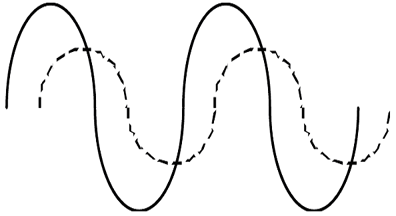
Fig. 1: Voltage and current waveforms are sinusoidal but out-of-phase; PF<1
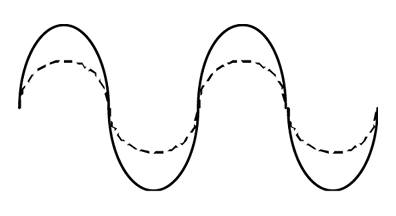
Fig. 2: Voltage and Current waveforms are sinusoidal and in-phase; PF=1
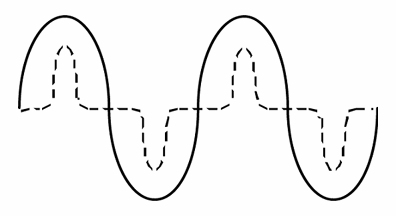
Fig. 3: Voltage waveform is sinusoidal, current waveform is non-sinusoidal but in-phase; PF<1