TDK-Lambda Italia
In alternativa, puoi contattarci così:
Dove e perché sono usati alimentatori DC in alta tensione?
It turns out that many power generation facilities provide a high voltage DC to power the plant's equipment rather than the regular 115Vac or 208Vac power grid. This high voltage DC (typically 120 or 130-330Vdc) can be easily used with batteries to provide a secure source of power rather than using expensive centralised or local UPS systems.
Now back to the subject. The topology of many switched-mode power supplies actually lends itself to operation from either AC or DC input. Important Note: Always check your power supply’s Operations Manual or spec sheet to confirm that it is designed to operate from either an AC or DC input.
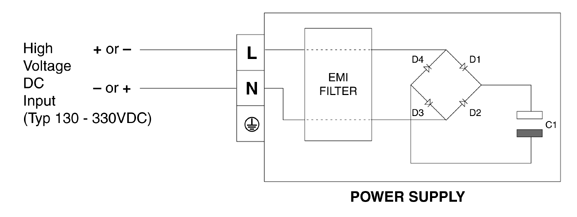
Referring to the simplified power supply schematic below:
When powered by an AC sine wave, during the first half cycle the current flows from the Line terminal through the input filter and charges capacitor C1 through diodes D1 and D3. During the second (negative) cycle, current flows from the Neutral terminal and capacitor C1 is charged through diodes D2 and D4.
When powered from a high voltage DC source, the polarity of the connection is not critical as far as the operation of the power supply is concerned. If the positive connection is made to the Line terminal, C1 is charged through diodes D1 and D3. If the positive connection is made to the Neutral terminal, then C1 is charged through diodes D2 and D4.
An important note of caution to insert here is about the protective fusing of the power supply. Safety certifications of the power supply may only apply to AC operation and should be checked carefully. Internally most power supplies have a fast acting AC rated fuse in series with the Line terminal. It is recommended that a DC rated fuse be installed external to the power supply. If one side of the high voltage DC buss is connected to ground, then the fuse is usually positioned in series with the "hot" side (the ungrounded side). It is recommended that you consult with your local safety engineer to be sure.