 TDK-Lambda UK
Alternatively, you can contact us like this:
This form is protected by Cloudflare and their Privacy Policy and Terms of Service apply.
What is Fold-Back Current Limiting?
When this method is employed if an overload condition exists, the output voltage and current reduce to safe levels. As can be seen from the following curve, should an overload occur the supply will provide current up its current limit point (aka 'knee'), and then the output current will fold-back to a lower value as the output voltage reduces towards zero.
This technique is employed in linear power supplies because it reduces the strain on the supply’s internal power devices to minimum. One drawback of fold-back current limiting is that if the supply turns on into a heavy capacitive load, it could latch-up at a reduced current before reaching its full output voltage. Depending upon the design, recovery from a fold-back current limit condition can be automatic, or after a built-in time delay when the overload condition is removed.
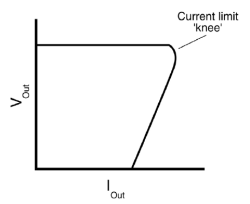
Fold-Back Current Limiting